
Fewer people control their exact retirement date than they assume. Restructuring, buyouts, AI-driven job changes, and severance can move the date without warning. A written plan, built before uncertainty hits, answers what guaranteed income you would have, whether to convert IRA assets, and how much risk to keep, so a hope does not have to.
A lot of high-income professionals I talk to are quietly worried about something they will not say out loud at work: they are not sure their retirement date is theirs anymore.
- A restructuring.
- A buyout offer.
- AI moving up the organizational chart.
- A severance package that lands before they were ready.
Here is what almost nobody connects: the moment your employment situation becomes uncertain is the worst possible time to start asking retirement planning questions—and the best possible time to have already answered them.
None of the four is rare anymore. What is rare is a household that has already answered the questions each one raises, before the letter or the offer arrives.
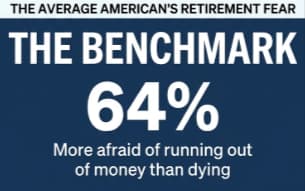
That quiet worry is not unusual. Two in three Americans now say they worry more about running out of money than about dying, up from 57% in 2022, according to the Allianz Life 2026 Annual Retirement Study. Gen X reports the sharpest version of that fear, at 73%. The people wondering whether their retirement date still belongs to them are not being dramatic. They are noticing something real.
A hope is not a written plan
If your plan only exists in your head—“I will work until 65, then we will figure it out”—you do not have a plan. You have a hope.
- A hope cannot tell you whether to take the severance and retire two years early.
- A hope cannot tell you whether to convert part of your IRA in the gap year between your last paycheck and Social Security.
- A hope cannot tell you how much guaranteed income you can lock in versus how much to keep at risk.
What can a modeled plan tell you that a hope cannot?
| Question | A hope | A modeled plan |
|---|---|---|
| Take the severance and retire two years early? | “We’ll see how it feels.” | A number: the guaranteed income you would have, and what gap remains. |
| Convert part of your IRA in the gap year before Social Security? | “Maybe, if we remember.” | A specific amount, sized to the tax bracket you choose to fill. |
| How much income to lock in versus keep at risk? | “We’ll figure it out.” | A defined income floor from Social Security, a pension, or an annuity, with the rest invested. |
The math has to exist before you need it. Not after.
What does “having the math” require?
Having the math is not a vague aspiration. It starts with two numbers sitting in a document before you need them.
A guaranteed income floor. What Social Security, any pension, and any annuity would produce if you stopped working on a given date, expressed in monthly dollars, not a portfolio balance.
A tax projection. What your household would owe across the next five to ten years under your current plan, and how that changes if you convert IRA assets during a low-income year.
Bridge costs until Medicare, the portfolio withdrawal rate, and the cash reserve all depend on those two numbers. Put together with a withdrawal order and a Social Security claiming age, those numbers are the core of what we call a Retirement Income Roadmap. Households that have never seen either number in writing are the ones most likely to describe a severance offer as a crisis rather than a decision.
What if the uncertainty is a buyout, not a layoff?
A buyout offer raises a different set of questions than a layoff does. It usually comes with a choice, a deadline, and a number attached to company stock, deferred compensation, or both. Company equity and buyout decisions deserve the same modeling as a severance package: what happens to unvested awards, what the tax treatment looks like if you accept, and whether the number on the table closes your income gap or just looks large in isolation.
Deferred compensation and unvested equity often accelerate or forfeit on a schedule tied to your separation date, not your preferred retirement date. That schedule is usually fixed well before the buyout conversation starts, which is one more reason the modeling has to exist ahead of time rather than during the negotiation window. If private equity is buying your employer, read what happens to your company equity in that kind of deal.
For some households, a buyout is the moment retirement moves up by years, not months. Our guide to retiring at 57 walks through what has to be true, a healthcare bridge, penalty-free access to accounts, and a portfolio sized for a longer retirement, before an early exit works.
A severance package raises a related but different question: not what you are giving up, but what the payout timing does to this year’s taxes. That decision deserves its own modeling too, separate from the retirement-date question, even though the two usually arrive together.
What does this mean for the two of you?
If your employer has not said anything yet, that is exactly the right time to build the plan, before uncertainty forces a rushed decision. Sit down together and answer three questions in writing: what guaranteed income would you have if you retired today, what would you owe in taxes on that income, and how many months of expenses do you have in cash if an offer needed an answer by Friday.
None of that requires an actual notice on the table. It requires the numbers to already exist, so that if the notice arrives, you are choosing from a plan instead of guessing under pressure.
If you already have a target retirement date, treat it as a hypothesis, not a certainty. Run the numbers as if that date moved two years earlier and two years later. If both versions of the plan still work, the actual date becomes a preference. If only one version works, you have found the constraint that controls your timeline, whether or not your employer ever says a word about it, and you will know it well before anyone forces the question.
Robert Boeck builds that plan before you need it, not after. Schedule a conversation and get the numbers on paper while the timeline is still yours to choose.
Common questions
- Can my employer force me to retire earlier than planned?
- Not directly in most cases, but restructuring, a buyout offer, or a severance package can make continuing to work impractical or impossible. Building your retirement numbers before any of that happens means a forced decision becomes a choice among modeled options instead of a scramble.
- What should I know before accepting a buyout offer?
- Model what happens to unvested equity, deferred compensation, and health coverage if you accept, alongside how the buyout amount compares to the guaranteed income you would still need before Social Security and Medicare begin. A number that looks large in isolation may or may not close your actual income gap.
- How do I know if I can afford to retire early?
- You need a modeled income floor: what Social Security, a pension, and any annuity produce, compared against your expected spending, including health insurance before Medicare eligibility at 65. Your portfolio has to cover the rest. Without that comparison, whether you can afford it is a guess dressed up as a decision.
- What is a Retirement Income Roadmap?
- A Retirement Income Roadmap is a written plan that lays out your income sources, withdrawal order, tax strategy, and Social Security timing for retirement, built before you need to act on it rather than after. It replaces guesswork with numbers you can review together.
If the decisions on this page are ahead of you, the two of you can work through them with Robert Boeck before any of them becomes permanent.
Schedule Your Consultation