Retirement Income Strategists

68% of Americans say preparing for retirement is becoming harder.

Feeling overwhelmed about retirement planning is normal. Staying overwhelmed is optional.

We make retirement income simple, clear, and built around you.

210+ Executives & Families Served

Source: National Institute on Retirement Security, Retirement Insecurity 2026: Americans’ Views of Retirement (August 2026).

Client Outcome · Anonymized
Retirement Income Forecast
Retire 57506580+
Net income Tax load
$14,200
Monthly Income
$218K
Tax Savings
Age 57
Target Retirement
94%
Plan Confidence
$131K MoreAverage Additional Lifetime Social Security Income
3 Years EarlierAverage Retirement Age Reduction
As featured in & recognized by
Tax Savings Estimator

See Your Potential Tax Savings

Adjust the sliders to model how a coordinated retirement income strategy could reduce your lifetime tax burden. This is illustrative. A full analysis requires a personalized engagement.

Your Financial Profile
Without Strategy
$1.0M
Estimated lifetime taxes
With Retirement Roadmap Experts Strategy
$445K
Estimated lifetime taxes
Estimated Lifetime Tax Savings
$584K
Based on Roth conversion, withdrawal sequencing and bracket management
Projected Tax Comparison by Decade
$300K$200K$100K$50K60–6565–7070–7575–80Without StrategyWith Strategy

Illustrative only. These figures come from a simplified model, not from your tax return, and they are not a projection of your results. A personalized analysis uses your actual account balances, brackets and timeline. Request a personalized analysis.

Retirement Readiness Assessment

How Ready Are You to Retire?

Answer 6 questions to receive a personalized retirement readiness score and identify your highest-priority planning opportunities.

Question 1 of 6

How many years until your target retirement date?

Why Strategy Matters

Coordinated Planning vs. A Collection of Opinions

Most pre-retirees don’t lack advice — you have a portfolio manager, CPA, and a rough plan for Social Security.

What you’re missing is the layer above those three: the sequencing decisions that tie tax strategy, withdrawal order, Roth conversion timing, and claiming decisions into a single income plan for both of you.

Decisions made in isolation tend to work against each other.

Decisions made together compound.

Planning Area
Without Strategy
With Retirement Roadmap Experts
Tax Rate in Retirement
28–35% effective, rising with RMDs
12–22% effective through bracket management
Roth Conversion
None. Large RMD burden builds unchecked
Multi-year strategy converts $800K–$2M tax-free
Withdrawal Sequencing
Simple depletion, no tax-rate awareness
Dynamic multi-account strategy saves $200K–$400K
Social Security
Claim at 62–65 without analysis
Optimized claiming adds $100K–$200K lifetime
Medicare Premiums (IRMAA)
Up to $628/mo surcharge per person unmanaged
Income managed to avoid or minimize surcharges
Retirement Date
65+, based on fear rather than a clear plan
57–62, engineered, precise, and confident
Deferred Compensation
Distributed without income coordination
Timed to bracket-optimal years, reducing tax spikes
Sequence of Returns Risk
Portfolio exposed to early-retirement drawdowns
Income buffer and bucketing strategy in place
Estimated Lifetime Difference
$0 in optimized outcomes
$250K–$600K+ in additional after-tax wealth

Estimates illustrative based on typical client profiles. Individual outcomes vary. Request a personalized analysis →

The Challenge

Your portfolio was built to grow.
Now it has to pay you for thirty years.

Most advisors manage investments.We build retirement income plans — the tax sequencing, withdrawal order, Social Security timing, and income floor decisions that determine whether your accumulated wealth actually carries you and your spouse through retirement.

Tax Exposure at Retirement

Without a coordinated tax strategy, executives often face much higher effective tax rates in retirement than they ever expected. Strategic Roth conversions and withdrawal sequencing can save six figures.

Sequence of Returns Risk

Retiring into a market decline without income buffers can permanently impair your portfolio, a risk that is manageable with proper distribution-phase strategy.

RMD Time Bomb

Large pre-tax balances create forced distributions at the worst possible time. Multi-year Roth conversion strategies during low-income years can defuse this threat before it ignites.

Healthcare Cost Bridge

Retiring before 65 means navigating the healthcare gap. The right strategy, including COBRA, ACA marketplace planning, and HSA utilization, turns this obstacle into a manageable transition.

Retiring Later Than Necessary

In our experience, many executives can retire 3 to 7 years earlier than they think. They simply lack a plan that makes the math work with clarity and confidence.

Inefficient Withdrawal Sequencing

The order in which you draw from taxable, tax-deferred, and tax-free accounts matters enormously, and most executives have never had it modeled comprehensively.

Deferred Compensation Traps

Non-qualified deferred compensation plans carry complex distribution rules, tax consequences, and creditor risks that require careful planning well before retirement.

Legacy Planning Gaps

Uncoordinated estate plans often leave heirs with substantial tax burdens. Integrating retirement income planning with legacy goals produces better outcomes for the whole family.

Our Process

The Retirement Income Roadmap

A structured five-phase framework tailored to the specific complexity of executive wealth, from comprehensive discovery through lifetime income distribution and legacy coordination.

Phase 01

Comprehensive Accumulation Assessment

We map every dimension of your financial architecture: investment accounts, deferred compensation, equity awards, pension benefits, insurance policies, real estate, business interests, and tax history. That builds a precise picture of where you stand and what is possible.

Financial DiscoveryTax History ReviewAsset InventoryLiability Analysis
Phase 02

Tax Optimization Window Strategy

The years between your final paycheck and age 73 are often the most valuable tax planning window of your entire financial life. We identify and execute Roth conversions, capital gain harvesting, charitable giving strategies, and deferred compensation restructuring to reduce your lifetime tax burden.

Roth ConversionsTax Loss HarvestingCharitable StrategyBracket Management
Phase 03

Early Retirement Transition Architecture

We engineer the income bridge from your final paycheck to full retirement income activation, coordinating equity liquidation, deferred compensation distributions, healthcare coverage, and cash flow timing to make your target retirement date a reality with confidence.

Income BridgeHealthcare PlanningEquity StrategyCashflow Timing
Phase 04

Retirement Income Distribution System

Your personalized withdrawal sequencing plan orders distributions from taxable, tax-deferred, and tax-free accounts to maximize after-tax income throughout a 30-year retirement while managing longevity, inflation, and market risk at the same time.

Withdrawal SequencingSocial Security TimingInflation DefenseLongevity Planning
Phase 05

Legacy & Estate Coordination

We integrate retirement income planning with your estate goals, coordinating with your estate attorney, optimizing beneficiary designations, structuring charitable giving, and implementing inherited IRA strategies to transfer wealth with maximum efficiency across generations.

Estate IntegrationBeneficiary StrategyCharitable PlanningInherited IRA
Financial Intelligence

Precision Data for Confident Decisions

Income Composition
Retirement Income Stream Breakdown
$14.2K/monthPortfolio (42%)Roth IRA (28%)Social Security (18%)Pension / Other (12%)
Roth Conversion Impact
Tax-Free Balance Growth Over 15 Years
$1.85M tax-free$410K tax-freeTodayYear 8Year 15With Roth StrategyWithout Strategy
30-Year Income Projection
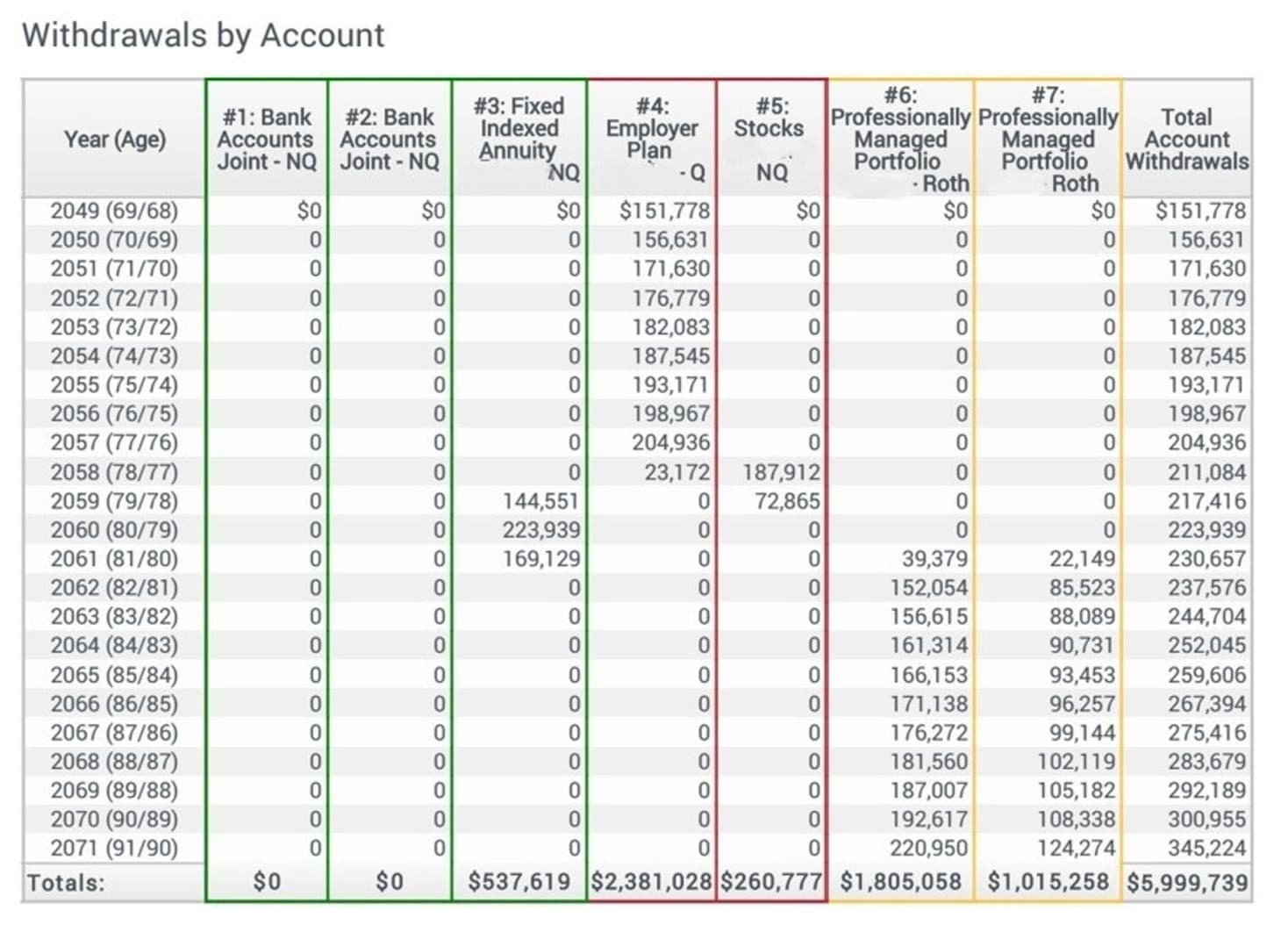
Retirement Withdrawal Waterfall — By Income Source
5760636669727578PortfolioRothSocial Security

All three charts illustrate a modeled scenario. They are not a projection of your results.

Our Services

Specialized Advisory Services

Every engagement is customized around your specific financial architecture, timeline, and life goals, rather than a template designed for the average investor.

01

Retirement Income Planning

Comprehensive modeling of every income source, tax implication, and timing decision that shapes your retirement financial life, synthesized into a single integrated roadmap.

Read more →
02

Tax-Efficient Withdrawal Strategy

Precision ordering of distributions from taxable, tax-deferred, and tax-free accounts, personalized to your specific tax situation, bracket, and income needs across decades.

Read more →
03

Roth Conversion Analysis

Multi-year Roth conversion strategies engineered to minimize lifetime taxes, identifying your optimal window, annual conversion amounts, and tax impact across decades.

Read more →
04

Executive Retirement Planning

Specialized guidance on non-qualified deferred compensation, restricted stock units, stock options, executive benefit plans, and concentrated position management.

Read more →
05

Social Security Optimization

Sophisticated claiming strategies, coordinated with your broader income plan, that can increase lifetime Social Security benefits by $100,000 or more for married couples.

Read more →
06

Early Retirement Feasibility

Rigorous analysis of whether your target retirement date is achievable, and a concrete financial engineering plan for closing any gaps between where you are and where you want to be.

Read more →
07

Ongoing Retirement Tax Planning

Forward-looking annual tax strategy, integrated with your CPA, to minimize taxes throughout retirement as laws, income, and financial circumstances evolve over decades.

Read more →
08

Legacy Planning Coordination

Integrating your retirement income plan with estate goals: beneficiary optimization, charitable strategies, and inter-generational wealth transfer designed for maximum efficiency.

Read more →
Client Results

Real Outcomes for Real Executives

Anonymized case illustrations representing the kind of outcomes that result from personalized retirement income planning. Individual results vary.

Tax Reduction
$218K
Reduction in projected lifetime taxes

CFO, Technology Sector — Retired at 59

A multi-year Roth conversion strategy executed during his final working years, combined with charitable remainder trust planning and deferred compensation restructuring, reduced his lifetime tax burden by $218,000. He retired six years ahead of his original plan.

Planned Retirement
Age 65
Actual Retirement
Age 59
Early Retirement
7 yrs
Earlier than her assumed retirement date

VP of Operations, Fortune 500 — Retired at 57

Analysis revealed an overlooked pension bridge option, an underutilized HSA with 20 years of compounding ahead, and a precise equity liquidation sequence that made retirement at 57 clearly financially viable. She had assumed 64 was the earliest possible.

Assumed Earliest Possible
Age 64
Actual Retirement
Age 57
Income Optimization
+$4,200
Additional monthly after-tax income

Business Owner, Professional Services — Age 62

By restructuring withdrawal sequencing, optimizing Social Security claiming for both spouses, and coordinating Roth conversions during low-income transition years, we increased his monthly after-tax retirement income by $4,200 without changing his retirement date or investment risk.

Monthly Income Before
$10,000
Monthly Income After
$14,200

Case illustrations are composites of typical client situations, not records of a specific engagement. Dollar figures are illustrative and are not a projection of your results.

Client Perspectives

What Our Clients Experience

★★★★★
I spent 30 years building wealth and two years dreading what to do with it. Working through the Retirement Income Roadmap was the first time I truly understood the full picture: the taxes, the timing, the income streams. I retired 5 years earlier than I thought possible.
Michael H.
Former SVP, Financial Services — Retired at 58
★★★★★
The Roth conversion strategy alone saved us more than $150,000 in projected taxes. More importantly, I finally have a clear picture of exactly how much we can spend in retirement without ever worrying about running out. That peace of mind is invaluable.
Sandra R.
CTO, Technology Company — Retired at 61
★★★★★
What distinguished this experience from every other financial advisor I've worked with was the specificity. Not general guidance, but a precise personalized roadmap that accounted for every dimension of my financial situation. I've never felt more confident about any financial decision.
David K.
Managing Director, Private Equity — Retired at 55

Clients are identified by first name and last initial at their request. Testimonials describe individual experiences and are not a guarantee of future results. No compensation was paid for these statements.

Robert Boeck, founder of Retirement Roadmap Experts
Robert Boeck
Founder & Lead Advisor
Our Philosophy

Building Wealth and Distributing It Are Two Different Jobs.

Most advisors are trained for the first: asset allocation, growth, accumulation.

I started Retirement Roadmap Experts around a conviction I'd watched play out for two decades: the financial industry is built for accumulation, and the people who need help most are the ones who've already done that part.

My work begins where most advisors' work ends. For couples two to eight years from retirement, the decisions that matter most aren't about picking investments. They're about tax sequencing across account types, Roth conversion timing in the low-bracket window between retirement and Required Minimum Distributions, withdrawal order, when each spouse claims Social Security, and how income holds up in a market that doesn't cooperate early. Those decisions interact. Made in isolation, they tend to work against each other. Made together, against the same assumptions and on the same timeline, they compound.

Every engagement produces the same three artifacts: a written retirement income plan, a multi-decade tax projection, and a coordinated Social Security and Roth conversion sequence, for both of you.

Knowledge Center

Executive Retirement Intelligence

In-depth analysis on the planning topics that matter most to senior executives and high-income professionals navigating the transition to retirement.

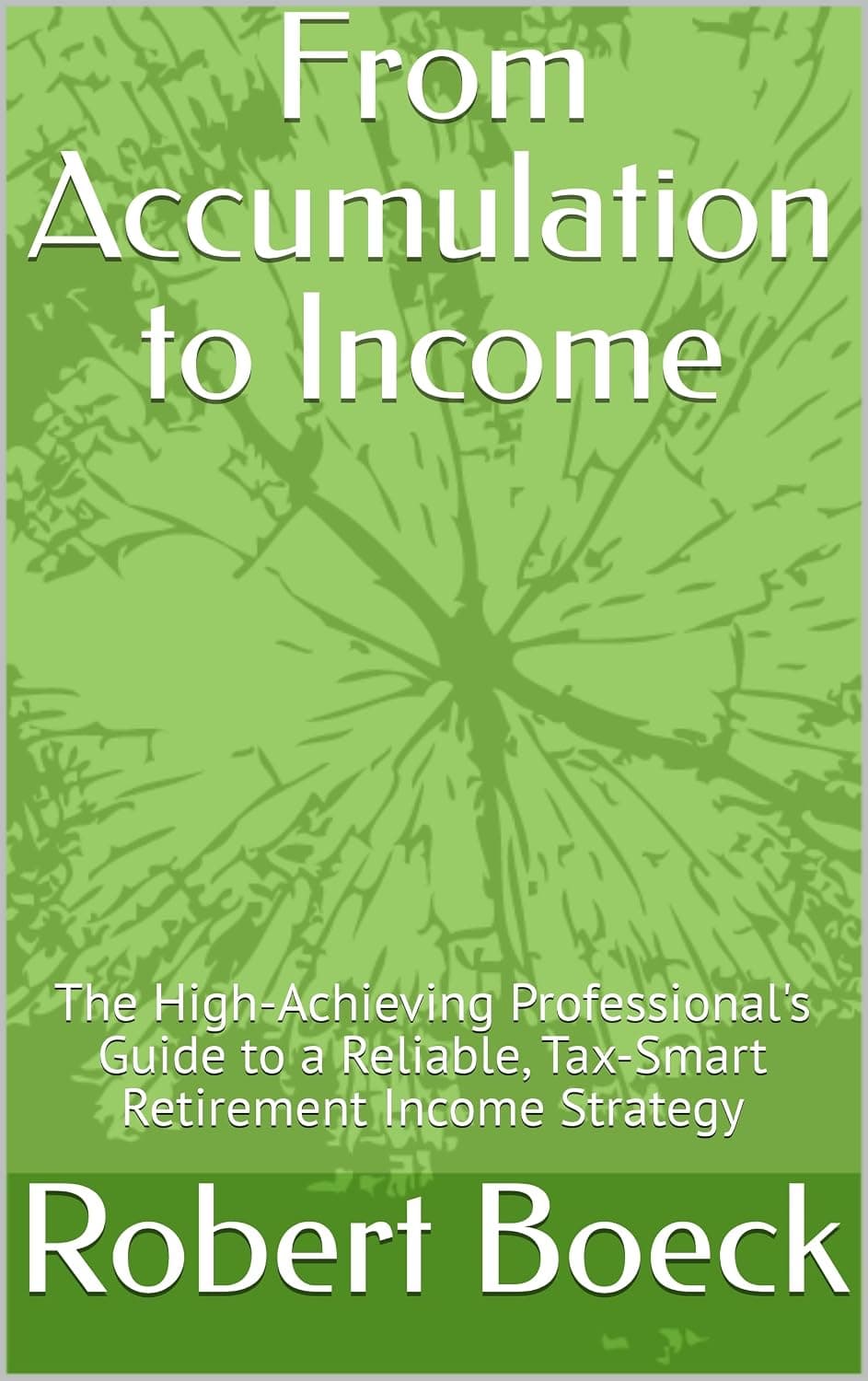
From Accumulation to Income book cover by Robert Boeck
Free Resource

From Accumulation to Income

The High-Achieving Professional’s Guide to a Reliable, Tax-Smart Retirement Income Strategy.

4 Self-Scoring Quizzes + Real Client Success Stories

Each chapter includes a self-assessment quiz so you can pinpoint exactly where your retirement income plan has gaps.

Real-World Outcomes

Client stories show how executives and professionals retired earlier than planned, reduced lifetime taxes by $150,000–$312,000, and finally answered: Am I going to be okay?

Primary-Source Planning

Every strategy is backed by primary sources: Kiplinger Personal Finance, the IRS Publication 590-B and RMD rules, the Social Security Administration delayed retirement credits and survivor benefit rules, and the Centers for Medicare & Medicaid Services IRMAA thresholds.

No spam. We respect your privacy.

Take the First Step

Ready to Build Your Retirement Income Roadmap?

A complimentary 30-minute consultation to assess your retirement readiness and identify your highest-value planning opportunities.

No sales pitch. No product recommendations. A genuine conversation about your retirement readiness.

Frequently Asked Questions

Expert Answers to Retirement Planning Questions

Detailed answers to the most consequential retirement income planning questions for senior executives and high-income professionals.

Key Concepts

Retirement Planning Glossary

Definitions of the terms and concepts that form the foundation of retirement income planning.

Retirement Income Planning

The comprehensive process of determining how to convert accumulated retirement assets into a sustainable, tax-efficient income stream throughout retirement. It encompasses withdrawal sequencing, Social Security optimization, tax management, healthcare planning, inflation protection, and legacy coordination.

Roth Conversion Strategy

A tax planning strategy involving the systematic transfer of assets from tax-deferred retirement accounts to tax-free Roth accounts. Taxes are paid in the year of conversion, and future growth and qualified withdrawals are tax-free.

Withdrawal Sequencing

The strategic ordering of retirement account withdrawals across taxable, tax-deferred, and tax-free accounts to minimize lifetime taxes and maximize after-tax retirement income.

Required Minimum Distributions (RMDs)

Mandatory annual withdrawals from tax-deferred retirement accounts that begin at age 73 under the SECURE 2.0 Act. All RMD income is taxed as ordinary income, and large pre-tax balances can force substantial taxable income.

Sequence of Returns Risk

The risk that the order in which investment returns occur, rather than the average return over time, permanently impairs a retirement portfolio. A decline in the early years of retirement, when withdrawals are active, forces asset sales at depressed prices.

IRMAA (Income-Related Monthly Adjustment Amount)

Medicare premium surcharges applied to beneficiaries whose Modified Adjusted Gross Income exceeds certain thresholds. Because the surcharge is based on your tax return from two years prior, the planning has to happen well before the bill arrives.

Non-Qualified Deferred Compensation (NQDC)

An employer arrangement that allows executives to defer compensation to a future date. Unlike a 401(k), NQDC distributions are subject to FICA at deferral and taxed as ordinary income at distribution, and the assets carry unsecured creditor risk.

Qualified Charitable Distribution (QCD)

A direct transfer from a traditional IRA to a qualified charity, available to IRA owners age 70½ or older. QCDs count toward satisfying RMDs but are excluded from taxable income, unlike charitable deductions that require itemizing.

Retirement Income Roadmap

A personalized plan covering every dimension of the transition from wealth accumulation to retirement income distribution: income stream analysis, tax optimization, withdrawal sequencing, Social Security planning, healthcare coverage, RMD management, and legacy coordination.

Provisional Income

The IRS calculation that determines how much of your Social Security benefit is subject to federal income tax. It equals Adjusted Gross Income plus tax-exempt interest plus half of your Social Security benefits.

Planning Insights

The Executive’s Framework for Retirement Income Mastery

In-depth strategic analysis of the retirement income decisions that define financial outcomes for senior executives and high-income professionals.

Foundational Strategy

Why the First 10 Years of Retirement Are the Most Important Tax Planning Window of Your Life

For most senior executives, the decade between their final paycheck and age 73 — when Required Minimum Distributions begin — represents an unprecedented opportunity to permanently restructure their tax position for the remaining 20–30 years of retirement.

During this window, income is often at its lowest point in decades: no salary, no RMDs, minimal capital gains. Tax brackets that were inaccessible during peak earning years suddenly open up. A disciplined Roth conversion strategy executed across this window can convert $800,000–$2,000,000 from taxable to tax-free status — at tax rates that may never be available again.

The executives who fail to capitalize on this window typically do so for one of three reasons: they don't recognize it as a planning opportunity, they fear paying tax today (without modeling the much larger future tax cost of inaction), or they lack an advisor who understands retirement income distribution well enough to execute the strategy.

At Retirement Roadmap Experts, mapping and maximizing this conversion window is the centerpiece of every Retirement Income Roadmap we build.

Roth ConversionTax OptimizationRMD Planning
Read more →
Executive-Specific Planning

The Four Financial Challenges Unique to Executive Retirement — And How to Solve Each One

Senior executives face retirement planning challenges that don't appear in mass-market financial planning guides — and that most advisors lack the specialized knowledge to address effectively.

1. Deferred compensation distribution timing. Non-qualified deferred compensation (NQDC) plans distribute income on a schedule set years earlier, often creating large tax spikes that weren't modeled when the deferral elections were made. Retroactively modifying these schedules is severely restricted; the solution requires working around the fixed schedule with coordinated strategies across other income sources.

2. Concentrated equity positions. Many executives accumulate significant positions in company stock through RSUs, ESPPs, and incentive stock options. Exiting these positions requires coordinating capital gain recognition, wash sale rules, IRMAA thresholds, and charitable giving strategies — none of which can be addressed in isolation.

3. Defined benefit pension optimization. When a pension offers lump-sum vs. annuity options, the right choice depends on longevity projections, survivor benefit needs, other income sources, portfolio diversification, and the specific actuarial terms of the plan — a decision that requires detailed modeling, not intuition.

4. Healthcare cost bridge. The gap between early retirement and Medicare eligibility is the most underestimated cost in executive retirement planning. Coordinating ACA marketplace eligibility with income management — keeping MAGI in ranges that qualify for meaningful premium tax credits — can save $30,000–$80,000 in healthcare costs during the bridge period.


Executive PlanningDeferred CompensationHealthcare Bridge
Read more →
Income Architecture

Building a Retirement Income Architecture That Lasts 30 Years

A retirement income architecture is more than a withdrawal plan — it is a multi-decade income system designed to deliver predictable, sustainable, inflation-adjusted cash flow across a retirement that may last 30–35 years.

The most resilient retirement income architectures for executives share four characteristics:

Diversified income sources across tax character. A portfolio that draws from taxable accounts (capital gains rates), tax-deferred accounts (ordinary income rates), and tax-free Roth accounts allows annual income management with precision that single-account strategies cannot achieve.

A reliable income floor. Covering essential expenses — housing, healthcare, food — with guaranteed or near-guaranteed income sources (Social Security, pension, possibly a deferred income annuity) creates psychological and financial stability that enables rational portfolio management during market volatility.

Structural protection against sequence risk. Whether through cash buffering, liability-matching bond ladders, or income annuities, effective retirement income architectures ensure that market downturns in the early retirement years cannot force distressed asset liquidations.

A documented spending policy. Research consistently shows that retirees with a written spending policy — including contingency rules for market downturns — experience better financial outcomes and lower financial anxiety than those who manage spending reactively.

Income ArchitectureSequence RiskPortfolio Strategy
Read more →
Take the First Step

Ready to Build Your Retirement Income Roadmap?

A complimentary 30-minute consultation to assess your retirement readiness and identify your highest-value planning opportunities.

No sales pitch. No product recommendations. A genuine conversation about your retirement readiness.