
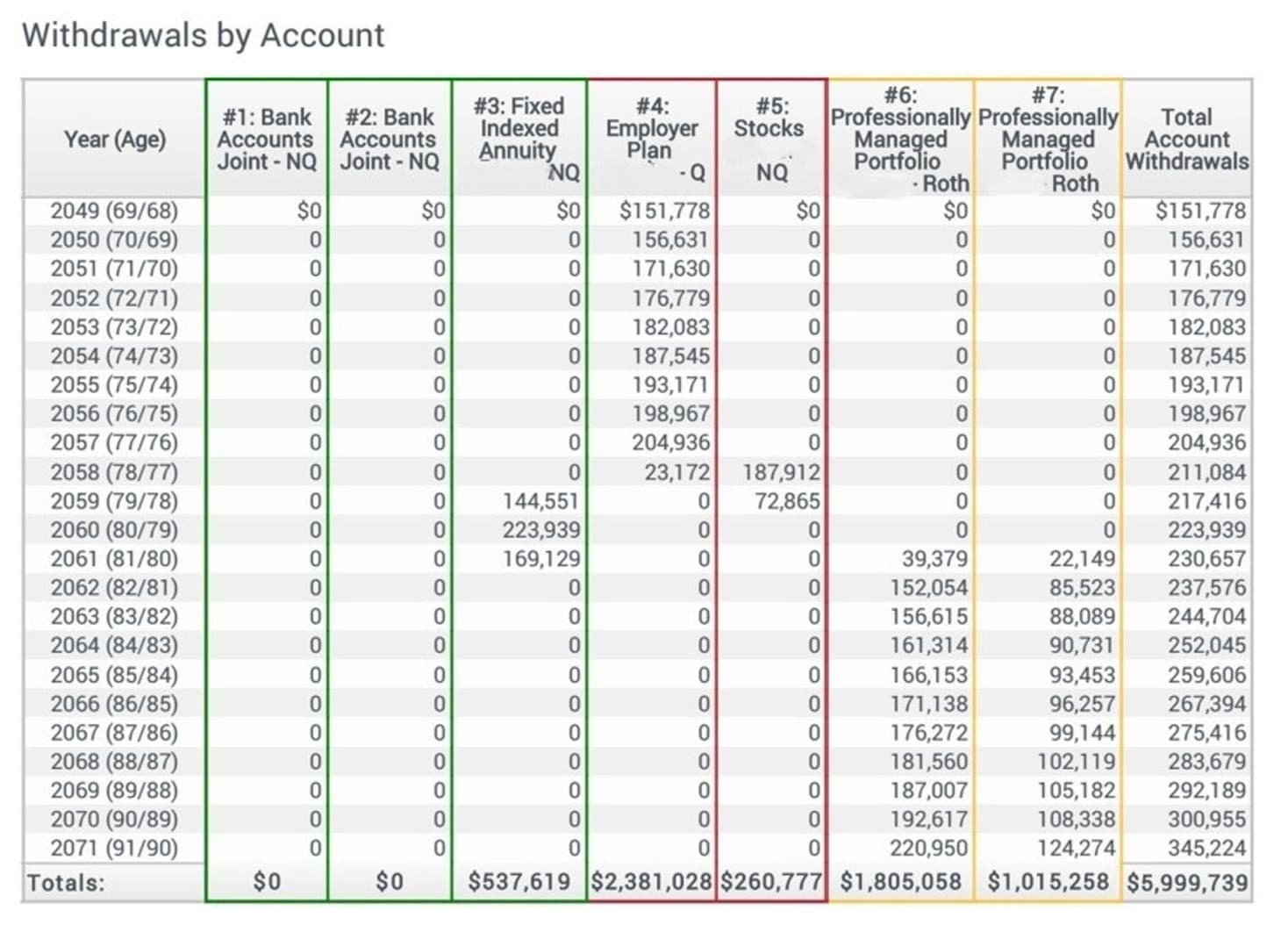
Comparing retirement income strategies means comparing withdrawal sequences, not just account balances. A retirement income plan assigns each account, whether a 401(k), Roth, brokerage account, annuity, or pension, a specific year and reason to be tapped, based on tax bracket, Social Security timing, and Required Minimum Distributions. The order determines how much of your money the IRS keeps.
Most pre-retirees can tell me exactly what they have.
Very few can tell me the order in which they will spend it. That is the gap between an investment portfolio and an actual retirement income plan.
Every account needs a job and a place in the sequence
The example shown above illustrates what a hypothetical sequenced withdrawal strategy can look like: 23 years, seven accounts, and every dollar accounted for. Each year shows which bucket to tap, how much, and why.
The seven accounts in a plan like this one are rarely exotic: often two joint bank or brokerage accounts held outside a retirement plan, a fixed indexed annuity, an employer retirement plan, a stock position, and one or two professionally managed Roth accounts. What makes the plan work is not the number of accounts. It is that each one has an assigned year and a stated reason.
Some years it is the 401(k). Some years it is the annuity. Some years it is the Roth. Each choice is deliberate. Each one carries a tax consequence—or avoids one. None of those choices is visible on a single account statement. They only become visible once every account is looked at together, on one page, across every remaining year of retirement.
The annuity years are usually not random either. A fixed indexed annuity or similar guaranteed product often gets used specifically in years when markets are down, so the household is not forced to sell depressed stock positions to cover spending. In stronger market years, the plan may lean more on the managed portfolio instead, letting it continue growing. The annuity is not the whole plan. It is one tool assigned a specific job in specific years, the same as every other account in the sequence.
If your “plan” is really a stack of statements and a hope that the math works out, that is not a plan.
What does a single year of that tax consequence look like?
Take one year in a hypothetical retirement, illustrative only. A couple needs $90,000 to cover spending. They could pull all of it from the 401(k), fully taxable as ordinary income, which could push them into a higher bracket. They could instead pull part from a taxable brokerage account, taxed at capital gains rates on the growth portion only, and part from a Roth account, taxed at nothing. The total spent is identical either way. The tax bill is not. Multiply that single-year choice by 20 or more years of retirement, and the gap between a sequenced plan and an unsequenced one compounds into a meaningfully different lifetime tax bill, even though both households spent exactly the same amount of money.
What determines which account to tap first?
The order is not arbitrary. It follows from a handful of questions asked every year: what tax bracket are you in, has Social Security started, are Required Minimum Distributions active yet, and do you have a large expense that a taxable account can absorb without triggering ordinary income tax. Under current IRS rules, RMDs begin at 73, or 75 if you were born in 1960 or later, which puts a hard deadline on the “later retirement” row below. The answers to those four questions change over time, which is why a sequence has to be revisited annually rather than set once and left alone.
A simplified version of that logic, illustrative only, breaks into three phases:
| Phase | Typical years | What usually funds spending | Why |
|---|---|---|---|
| Early retirement | Before Social Security and RMDs | Taxable brokerage accounts, plus Roth conversions in the same years | Capital gains rates are often lower than ordinary income rates, and low income creates room to convert |
| Middle retirement | Social Security active, before RMDs begin | Social Security, pension, a mix of Roth and taxable | Coordinating with provisional income limits keeps more of Social Security untaxed |
| Later retirement | RMD age (73 or 75) and beyond | Required Minimum Distributions, supplemented by Roth for large expenses | RMDs must come out regardless of need, so the Roth account absorbs spending RMDs do not cover |
Every household’s version of this table looks different. A pension changes it. A concentrated stock position changes it. A spouse five years younger changes it. The structure stays the same: every account gets a job, and the job changes as the phases change.
A market downturn in the first few retirement years adds one more layer: selling from a depressed account to fund spending can lock in losses the portfolio never gets to recover from. That is sequence of returns risk, and it is one more reason the account you tap in a given year matters as much as how much you withdraw.
What does this mean for the two of you?
Pull your most recent statement for every account: 401(k), IRA, Roth, brokerage, annuity, pension. For each one, write down what year you expect to start drawing from it and why. If you cannot answer “why” for every account, you have a list of assets, not a withdrawal sequence.
If two or more of your accounts have never been assigned a year, that is not a small gap. It usually means the household plans to figure out the order later, under pressure, in whatever year a decision becomes unavoidable. The order is easier to build now, with no deadline attached, than during a market downturn or a surprise expense.
Our withdrawal sequencing guide walks through how to build that order year by year. If the only decision in front of you is where to start, see our short answer on which account to withdraw from first. Either way, start with this year and next year, not all 23 at once. A sequence only needs to be right a few years ahead of where you stand, with the later years adjusted as your actual numbers come in.
Robert Boeck builds the sequence, not just the list. Schedule a conversation and see what a year-by-year withdrawal order looks like for your accounts.
Common questions
- What is a retirement withdrawal sequence?
- A withdrawal sequence is the planned order in which you draw from taxable, tax-deferred, and tax-free accounts each year of retirement, chosen to manage your tax bracket rather than depleting one account before moving to the next. The right order changes as your income sources and age change.
- Which account should I withdraw from first in retirement?
- There is no single answer that fits every household. It depends on your tax bracket, whether Social Security has started, whether Required Minimum Distributions are active, and what other income you have that year. Many households draw from taxable accounts first, but the right order is specific to your numbers.
- Why does the order of withdrawals matter if the total amount is the same?
- Because taxes are calculated year by year, not over your lifetime. Withdrawing the wrong amount from the wrong account in a given year can push you into a higher bracket, increase the taxable portion of Social Security, or trigger a Medicare premium surcharge, even if the total withdrawn over time is identical.
- What happens to my withdrawal sequence once RMDs begin?
- Required Minimum Distributions must come out of tax-deferred accounts starting at 73, or 75 if you were born in 1960 or later, regardless of whether you need the income. At that point, the sequencing question shifts to how you use other accounts, including Roth withdrawals and Qualified Charitable Distributions, to manage the income RMDs force onto your return.
If the decisions on this page are ahead of you, the two of you can work through them with Robert Boeck before any of them becomes permanent.
Schedule Your Consultation