
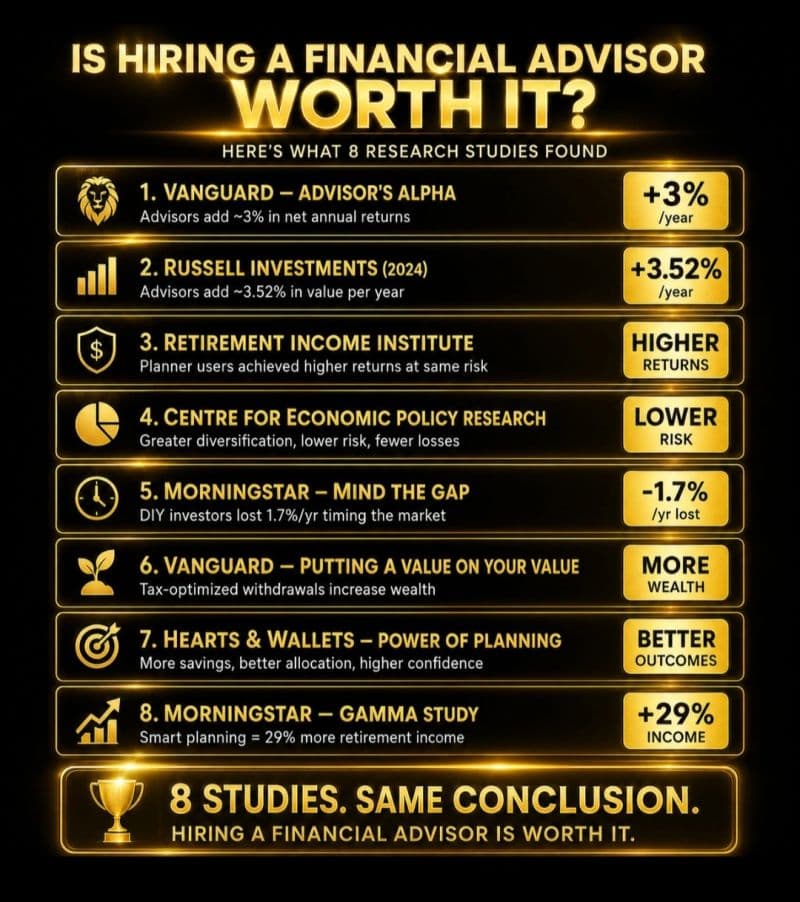
Studies on whether a financial planner is worth it mostly measure accumulation: returns, growth, and allocation. Near retirement, the discipline changes to distribution: tax bracket management, withdrawal sequencing, Social Security timing, and an income floor. A planner worth hiring for the first job is not automatically equipped for the second.
A graphic making the rounds on social media points to eight studies and one conclusion: hiring a financial advisor is “worth it.” I do not disagree. Research from Vanguard, Morningstar, Russell and others has measured the value a good advisor may add.
But look closely at what most of those studies emphasize: returns, growth, and accumulation.
Near retirement, the game changes
For a couple two to eight years from retirement, the question is no longer simply, “How much more can we grow this?” It is, “How do we turn what we built into income we will not outlive—while keeping taxes, one bad market year, and a pre-Medicare healthcare gap from quietly eating it?”
That is a different discipline.
Investment management is about your portfolio. Retirement income planning is about your tax bracket, withdrawal sequence, Social Security timing, and a floor of income that does not move when the market drops 30%.
The data backs that up. In a 2026 survey of 478 advisors, 66% listed retirement income planning among their top three services, but nearly six in ten of those advisors demonstrated only basic or intermediate proficiency in it, according to The American College of Financial Services. Offering a service and being deep in it are not the same claim.
What’s different between accumulation and distribution planning?
| Accumulation (what the studies measure) | Distribution (the years near retirement) | |
|---|---|---|
| Core question | How much more can this grow? | How much can we spend, and from where? |
| Time horizon | Decades | Year by year, often decided annually |
| Main lever | Asset allocation, savings rate | Withdrawal sequencing, Roth conversions, Social Security timing |
| What a mistake costs | A smaller balance later | A higher tax bracket this year, or an IRMAA surcharge two years later |
What does distribution-phase work look like in practice?
It shows up as specific, recurring tasks rather than a single meeting.
An annual tax projection, run before year-end, that shows what happens to your bracket if you take no action versus if you convert a specific amount to a Roth account.
A Social Security review, updated whenever a job change, health change, or market move alters the assumptions behind your original claiming plan.
These are not one-time deliverables. They repeat every year because the inputs change every year: tax law, account balances, health, and market conditions. A financial plan handed to you once, then revisited every few years, looks closer to accumulation-era service than to retirement income planning.
Consider a couple with $2.2 million split across a 401(k), a taxable brokerage account, and a small Roth IRA, an illustrative case, not an actual client. Spending only from the 401(k) each year is simple, but it can push their taxable income higher than necessary, trigger a Medicare premium surcharge two years later, and leave the Roth account, their most flexible money, untouched until it stops being useful. Drawing from all three accounts in a planned order does not eliminate taxes. It controls when and how much you pay, year by year. Over 20 or 25 years of retirement withdrawals, those yearly differences add up, and the lifetime tax bill becomes the actual stakes of the comparison, not the advisor’s fee.
You can do everything right on growth and still hand the IRS far more than necessary over a 25-year retirement.
The graphic is not wrong. It is answering an accumulation question for people who may have already moved on to a distribution one. If you and your spouse are within a few years of retirement and have never had a real conversation about income, taxes, and sequencing—no products, no pitch—that gap is worth closing while there is still time to act.
What should you ask an advisor to find out if they do this work?
Three questions tend to surface the answer quickly. Ask how often they run a tax projection for you, not a portfolio review, a tax projection. Ask whether they have modeled your Social Security claiming decision against your spouse’s, specifically, not in general terms. Ask what their process is for deciding which account to draw from in a given year, and whether that process changes as RMDs approach.
Vague answers to any of the three are informative on their own. A planner doing real distribution work will have a specific, repeatable answer, because the work itself is specific and repeatable. A planner focused on accumulation will often redirect the conversation back to performance and allocation, a fine answer to a different question.
None of this makes accumulation-focused advice worthless. A well-managed portfolio is still the foundation everything else draws from. The point is narrower: growing the number and spending the number down efficiently are different skills, and a household within a few years of retirement needs both, not just the one that got them here.
What does this mean for the two of you?
Before you decide whether a financial planner is worth the fee, ask a narrower question: worth it for what? A planner who reviews your allocation once a quarter is worth it for the job accumulation research measures. A planner who builds a written withdrawal sequence, models your tax bracket year by year, and coordinates your Social Security claim with your spouse’s is worth it for a different job, one most of the cited research never tested.
Our withdrawal sequencing guide shows what that second job involves. And if you are weighing a retirement income planner against a general financial advisor, that comparison is worth reading before your next renewal conversation, not after.
If your current advisor has never run a specific tax projection for your household, or cannot describe your Social Security claiming plan in a sentence, that gap is worth naming directly, even if the relationship has worked well for 20 years of accumulation.
Robert Boeck works the distribution side exclusively: tax sequencing, Social Security timing, and an income floor built to hold up in a bad market year. Schedule a conversation to see what that looks like for your numbers.
Common questions
- Is a financial planner worth the fee near retirement?
- It depends on the job. Studies showing advisors add value largely measure accumulation-era work: allocation, rebalancing, and staying invested through downturns. Near retirement, the more relevant question is whether the planner also does distribution work: withdrawal sequencing, Roth conversion timing, and Social Security coordination. Ask specifically which job you are paying for.
- What is the difference between accumulation planning and distribution planning?
- Accumulation planning focuses on growing assets: savings rate, allocation, and time in the market. Distribution planning focuses on converting those assets into income while managing the tax bracket, sequence of withdrawals, and Social Security timing that determine how long the money lasts and how much of it the IRS keeps.
- Do most financial advisors specialize in retirement income planning?
- No. Most advisors say they offer it, and fewer specialize in it. A specialist runs your tax projection each year and can name the account that funds that year’s spending.
If the decisions on this page are ahead of you, the two of you can work through them with Robert Boeck before any of them becomes permanent.
Schedule Your Consultation