
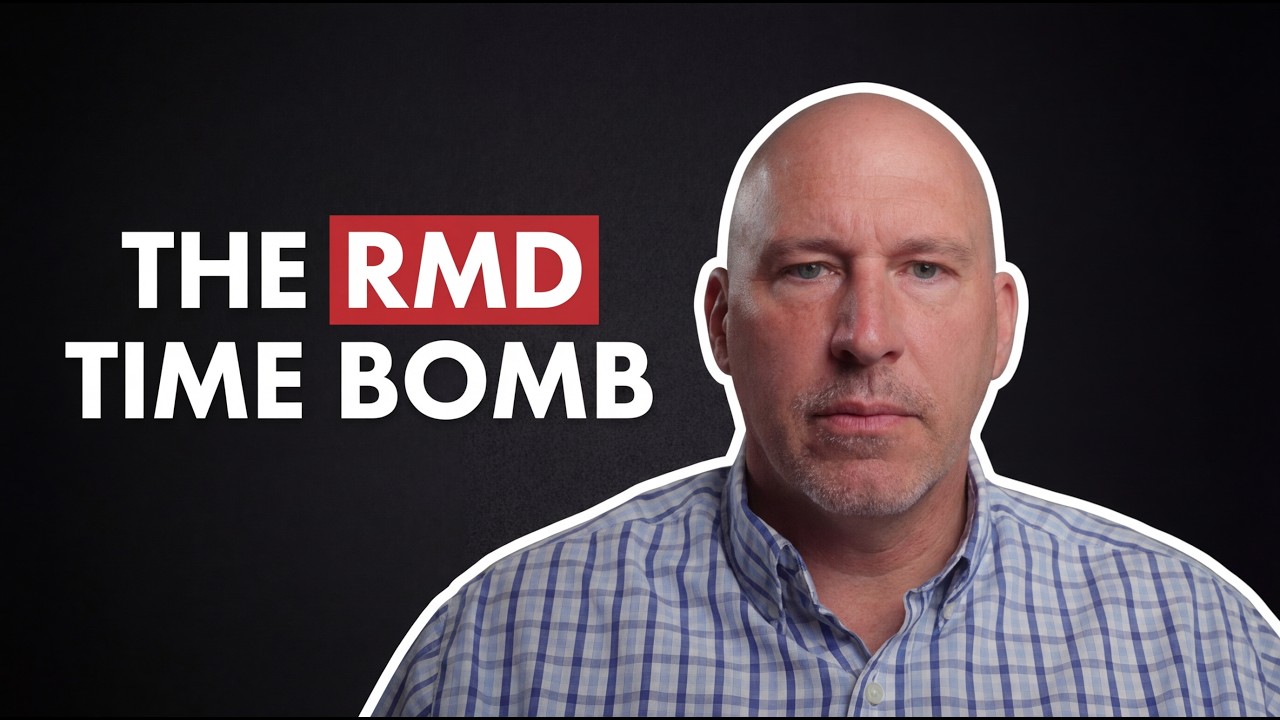
Required minimum distributions add taxable income whether you need it or not. On a large pre-tax balance, that income can lift your tax bracket, push your MAGI over an IRMAA threshold two years later and make up to 85% of your Social Security taxable. Roth conversions made before RMDs start shrink all three.
Why isn’t your 401(k) balance what you keep?
Money in a traditional 401(k) or IRA has never been taxed, and Robert describes the IRS as a silent partner in the account. In his description of this video, a $2 million 401(k) may deliver about $1.5 million in spendable income once the tax is paid. Required minimum distributions start at 73, or 75 for people born in 1960 or later, and the IRS sets the minimum each year whether you need the money or not. The larger the balance at 73, the larger every forced withdrawal after it.
A worked example from the RMD glossary entry: a $1.5 million traditional IRA growing at 6% a year from age 67 reaches about $2.1 million at 73. The IRS life expectancy factor at 73 is 26.5, so the first RMD is close to $79,000 of taxable income, on top of Social Security and anything else on the return. The figures are illustrative.
How do RMDs raise your Medicare premiums?
Medicare adds IRMAA surcharges to Part B and Part D premiums once your modified adjusted gross income crosses a threshold, and it uses your tax return from two years earlier. An RMD is ordinary income, so it counts in full. A large distribution at 73 can move you into a surcharge tier at 75, on top of the income tax itself. The Medicare costs page lists the current tiers, and the answer on what IRMAA is explains how the lookback works.
How do RMDs make Social Security taxable?
The IRS decides how much of your Social Security benefit to tax with a formula called provisional income: your adjusted gross income, plus tax-exempt interest, plus half your benefit. Above $44,000 for a married couple, or $34,000 for a single filer, up to 85% of the benefit becomes taxable, under the rules in IRS Publication 915. Those thresholds are not indexed to inflation. Every dollar of RMD raises provisional income, so the distribution can pull more of your Social Security into your taxable income at the same time.
What can you do before 73?
The years between your last paycheck and the start of RMDs are the window. Your taxable income often drops in those years, and Roth conversions made then move pre-tax money out at a rate you choose, which shrinks the balance the RMD formula applies to later. Robert aims this video at households with more than 70% of their savings in pre-tax accounts and no Roth conversion plan yet. For them, three numbers are worth seeing before the window closes: the RMD your balance projects at 73, where that income lands against the IRMAA tiers and the provisional income thresholds, and how much you could convert each year until then. The pages on when to do Roth conversions and RMD exposure go through the math, and Robert’s 30-minute retirement clarity call runs it with your balances.
Common questions
- Does an RMD count toward IRMAA?
- Yes. A required minimum distribution is ordinary income, so it counts toward the modified adjusted gross income Medicare uses to set IRMAA surcharges, based on your tax return from two years earlier.
- How much of Social Security can be taxed?
- Up to 85% of your benefit, once provisional income passes $44,000 for a married couple filing jointly or $34,000 for a single filer. Those thresholds are not indexed to inflation, so more retirees cross them each year.
- Can Roth conversions reduce future RMDs?
- Yes. Each dollar converted before RMDs begin leaves the pre-tax account, so the balance the IRS formula applies to at 73 is smaller, and so is every required withdrawal after it. You pay tax on the conversion in the year you make it.
If the decisions on this page are ahead of you, the two of you can work through them with Robert Boeck before any of them becomes permanent.
Schedule Your Consultation